Ancient and modem, with equal measures of grunge and grace, bustling Athens is a heady mix of history and edginess. Iconic monuments mingle with first-rate museums, lively cafes and alfresco dining, and downright fun.
This was they first capital city that we visited in June 1996 on a day trip from Skiathos. As we had only a very short time this page is not very exhaustive however, the experience of Athens was amazing and is one city that we plan to go back to and spend more time.
The Acropolis
The Acropolis of Athens is an ancient citadel located on an extremely rocky outcrop above the Athens and contains the remains of several ancient buildings of great architectural and historic significance, the most famous being the Parthenon. The word acropolis comes from the Greek words ἄκρον (akron, “highest point, extremity”) and πόλις (polis, “city”). Although there are many other acropoleis in Greece, the significance of the Acropolis of Athens is such that it is commonly known as “The Acropolis” without qualification.
While there is evidence that the hill was inhabited as far back as the fourth millennium BC, it was Pericles (c. 495 – 429 BC) in the fifth century BC who coordinated the construction of the site’s most important buildings including the Parthenon, the Propylaia, the Erechtheion and the Temple of Athena Nike. The Parthenon and the other buildings were seriously damaged during the 1687 siege by the Venetians in the Morean War when gunpowder being stored in the Parthenon was hit by a cannonball and exploded.
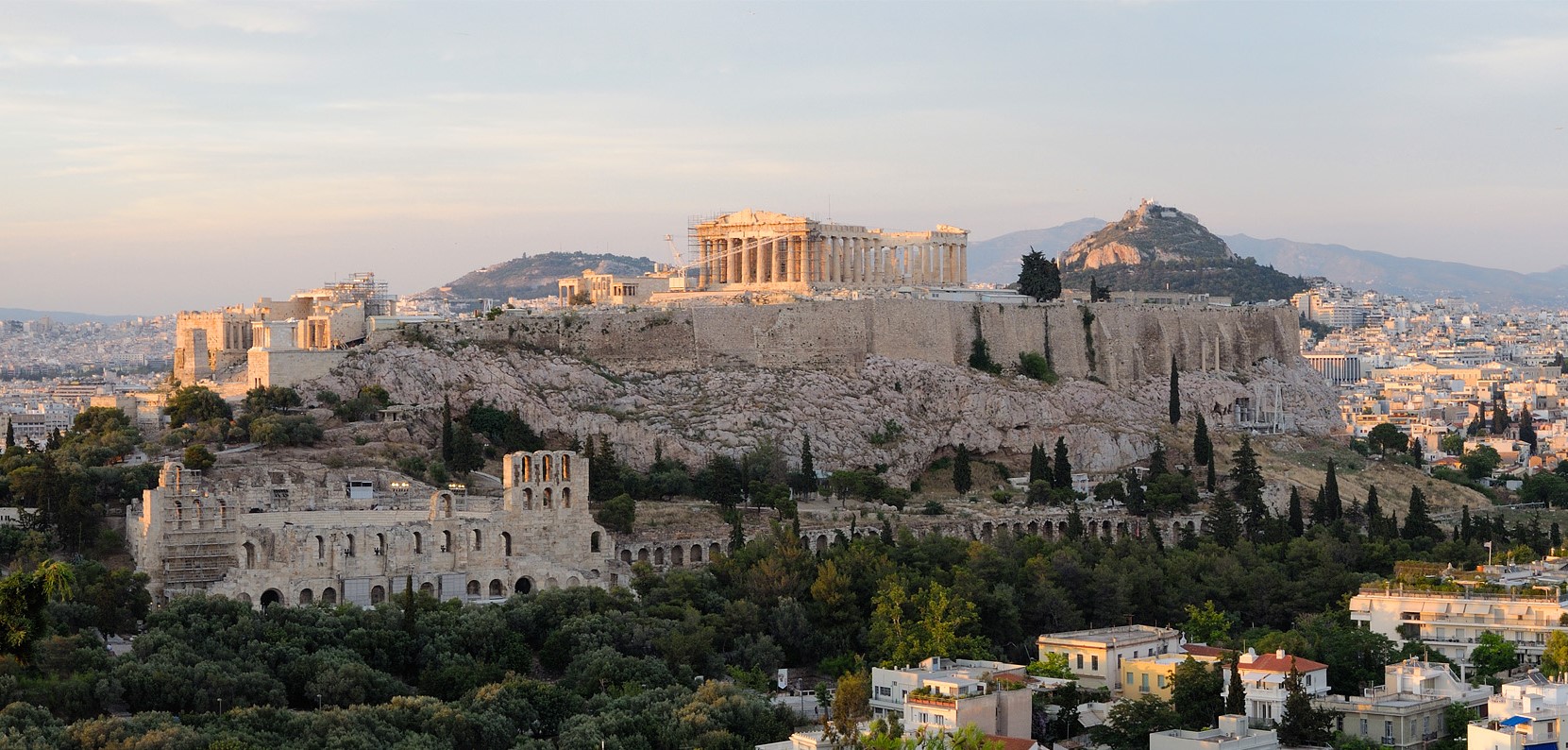
The Parthenon
After winning at Eurymedon in 468 BC, Cimon and Themistocles ordered the reconstruction of the southern and northern walls of the Acropolis. Most of the major temples, including the Parthenon, were rebuilt under the leadership of Pericles during the Golden Age of Athens (460–430 BC). Phidias, an Athenian sculptor, and Ictinus and Callicrates, two famous architects, were responsible for the reconstruction.
In 437 BC, Mnesicles started building the Propylaea, a monumental gate at the western end of the Acropolis with Doric columns of Pentelic marble, partly built upon the old propylaea of Peisistratos. These colonnades were almost finished in 432 BC and had two wings, the northern one decorated with paintings by Polygnotus. Around the same time, south of the Propylaea, building started on the small Ionic Temple of Athena Nike in Pentelic marble with tetrastyle porches, preserving the essentials of Greek temple design. After an interruption caused by the Peloponnesian War, the temple was finished in the time of Nicias’ peace, between 421 BC and 409 BC.

The National Archaeological Museum
The National Archaeological Museum houses some of the most important artefacts from a variety of archaeological locations around Greece from prehistory to late antiquity. It is considered one of the greatest museums in the world and contains the richest collection of artefacts from Greek antiquity worldwide.
 Heather and Keith's travels