Berlin is a wonderful city which has very warm summers and cold winters. It is very cosmopolitan with lots of people from different cultures living together. The people are friendly and not typically German in their manner.
The city is fairly small and easily navigated both on foot or by train, underground, tram or bus. This is one of our favourite cities so far in the tour of European capital cities.
We visited in Berlin in July 2016 and stayed at the Adina Aparthotel in the Hackescher Markt district of Berlin, very close to a railway station.
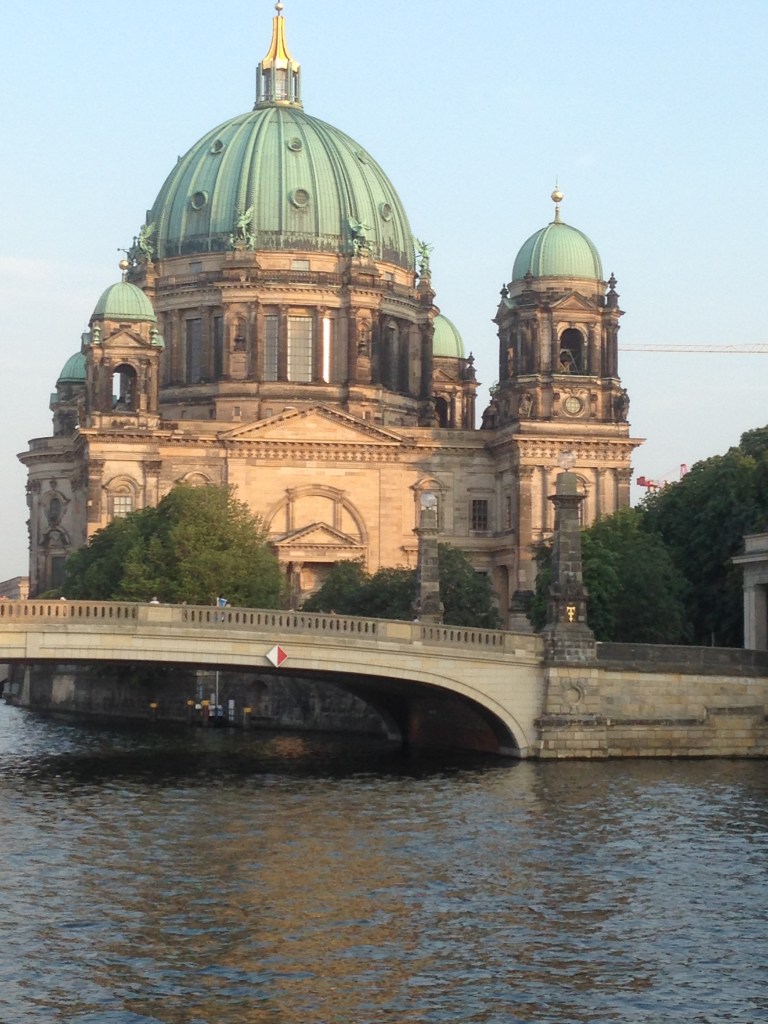
Berlin Cathedral
The current Cathedral, known as the Berlin Dom, was built in the late 19th and opened on 27 February 1905 .
In 1940 the blast waves of Allied bombing blew part of the windows away. On 24 May 1944, a bomb of combustible liquids entered the roof lantern of the dome. The fire could not be extinguished at that unreachable section of the dome. So the lantern burnt out and collapsed into the main floor. Between 1949 and 1953 a temporary roof was built to enclose the building.
In 1975 reconstruction started and was finished in 1980 when the baptistery and wedding church was reopened for services. The restoration of the nave started in 1984 and finished on 6 June 1993. The restoration of the dome and surrounding cupolas to their original appearance, but this has not occurred due to lack of funds
Reichstag
The Reichstag building is a historical building which was constructed to house the Imperial Diet (German Assembly) of the German Empire. It was opened in 1894 and housed the Diet until 1933, when it was severely damaged after it was set on fire. After World War II, the building fell into disuse; the parliament of the German Democratic Republic (the Volkskammer) met in the Palast der Republik in East Berlin, while the parliament of the Federal Republic of Germany (the Bundestag) met in the Bundeshaus in Bonn.
The ruined building was partially refurbished in the 1960s, but no attempt at full restoration was made until after German reunification on 3 October 1990, when it underwent a reconstruction led by architect Norman Foster. After its completion in 1999, it once again became the meeting place of the German parliament: the modern Bundestag.

Berlin Wall
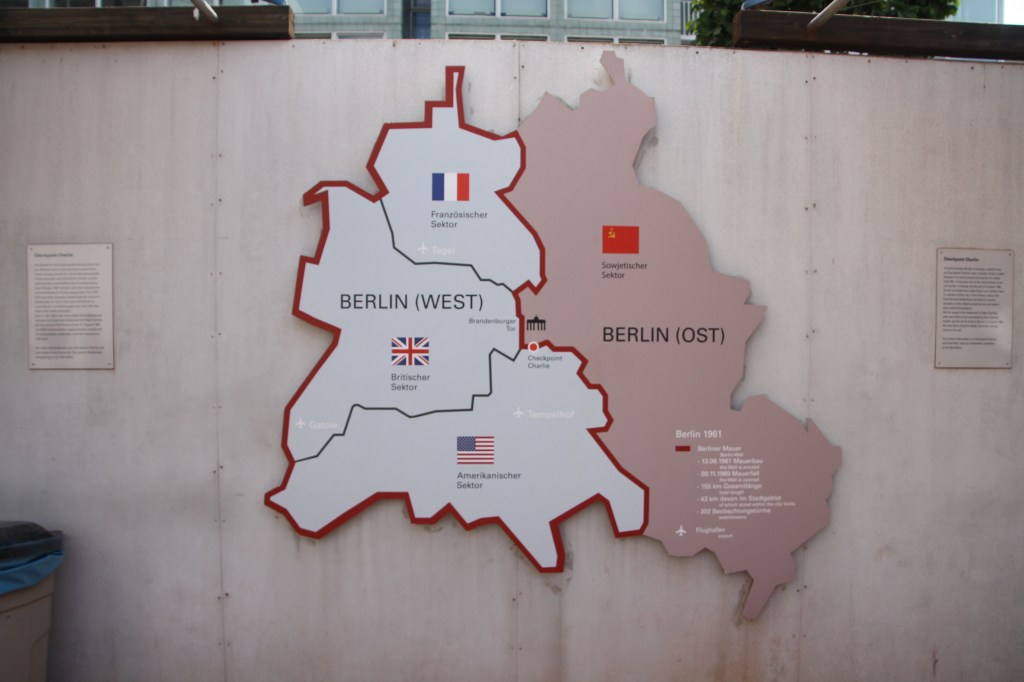
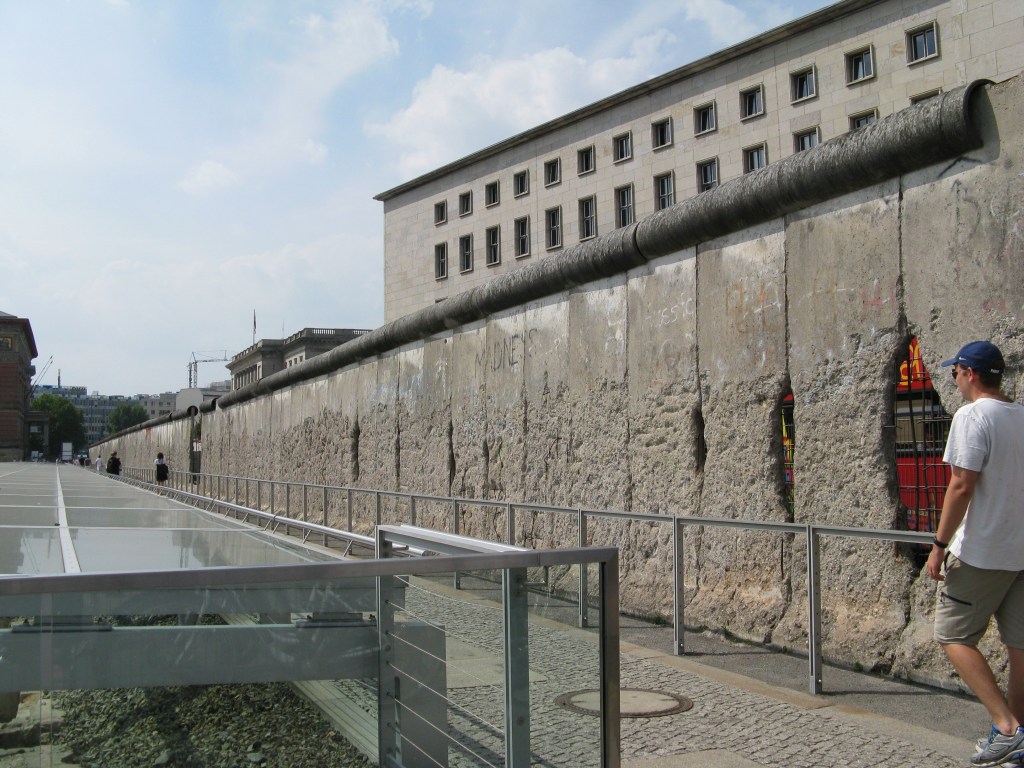
The Berlin Wall was a barrier that divided Berlin from 1961 to 1989.It was constructed by the German Democratic Republic (GDR, East Germany), starting on 13 August 1961, the Wall completely cut off (by land) West Berlin from surrounding East Germany and from East Berlin. The barrier included guard towers placed along large concrete walls, which circumscribed a wide area (later known as the “death strip”) that contained anti-vehicle trenches, “fakir beds” and other defences. The Eastern Bloc claimed that the Wall was erected to protect its population from fascist elements conspiring to prevent the “will of the people” in building a socialist state in East Germany. In practice, the Wall served to prevent the massive emigration and defection that had marked East Germany and the communist Eastern Bloc during the post-World War II period. Between 1961 and 1989, around 5,000 people attempted to escape over the Wall, with an estimated death toll ranging from 136 to more than 200 in and around Berlin.
The fall of the Eastern Bloc’s in 1989 the East German government announced on 9 November 1989 that all GDR citizens could visit West Germany and West Berlin. Crowds of East Germans crossed and climbed onto the Wall, joined by West Germans on the other side in a celebratory atmosphere. Over the next few weeks, euphoric people and souvenir hunters chipped away parts of the Wall; the governments later used industrial equipment to remove most of what was left. Contrary to popular belief the Wall’s actual demolition did not begin until the summer of 1990 and was not completed until 1992. The fall of the Berlin Wall paved the way for German reunification, which was formally concluded on 3 October 1990.
Checkpoint Charlie
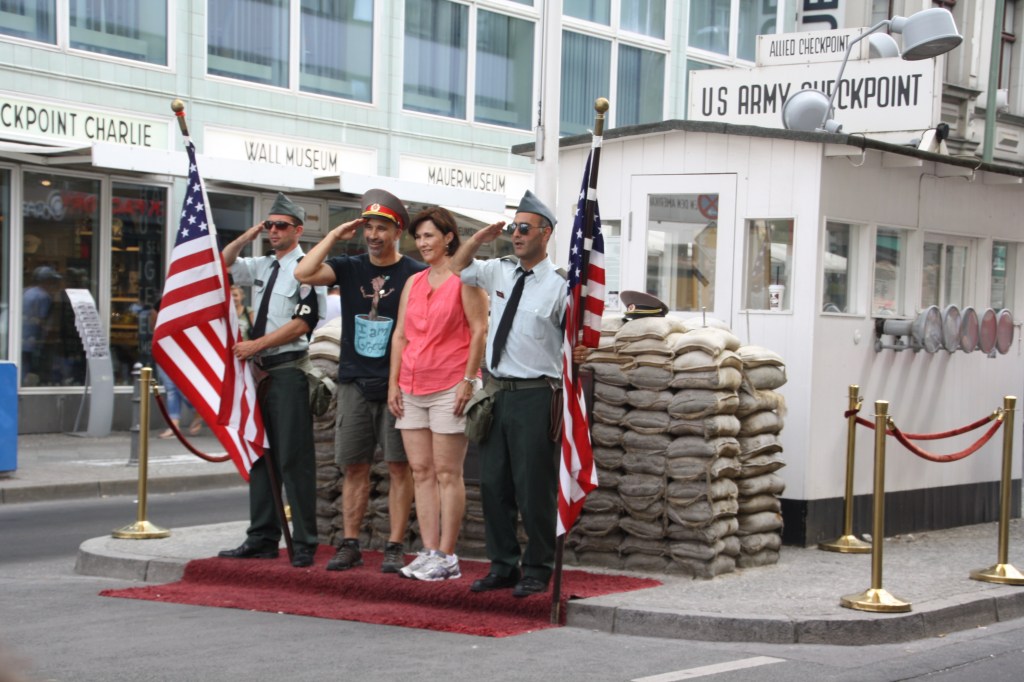
Checkpoint Charlie (or “Checkpoint C”) was the name given by the Western Allies to the best-known Berlin Wall crossing point between East Berlin and West Berlin during the Cold War.
GDR leader Walter Ulbricht got the Soviet Union’s permission to construct the Berlin Wall in 1961 to stop Eastern Bloc emigration westward through the Soviet border system, preventing escape across the city sector border from communist East Berlin into free West Berlin. Checkpoint Charlie became a symbol of the Cold War, representing the separation of East and West. Soviet and American tanks briefly faced each other at the location during the Berlin Crisis of 1961.
After the dissolution of the Eastern Bloc and the reunification of Germany, the building at Checkpoint Charlie became a tourist attraction. It is now located in the Allied Museum in the Dahlem neighbourhood.
Brandenburg Gate
The Brandenburg Gate (German: Brandenburger Tor) is an 18th-century neoclassical monument and is one of the best-known landmarks of Germany. It is built on the site of a former city gate that marked the start of the road from Berlin to the town of Brandenburg an der Havel.
It is located in the western part of the city centre within Mitte, at the junction of Unter den Linden and Ebertstraße, immediately west of the Pariser Platz. One block to the north stands the Reichstag building that houses the German parliament (Bundestag). The gate is the monumental entry to Unter den Linden, the renowned boulevard of linden trees, which led directly to the royal City Palace of the Prussian monarchs.
Throughout its existence, the Brandenburg Gate was often a site for major historical events and is today considered a symbol of the tumultuous history of Europe and Germany, but also of European unity and peace.

Holocaust Memorial
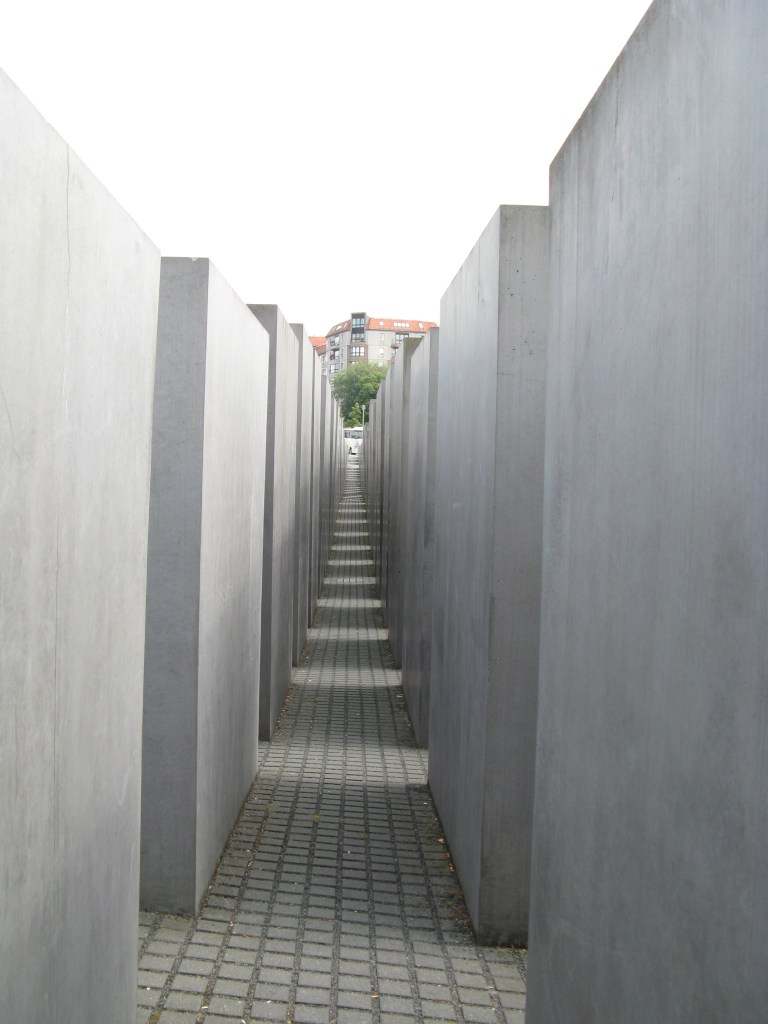
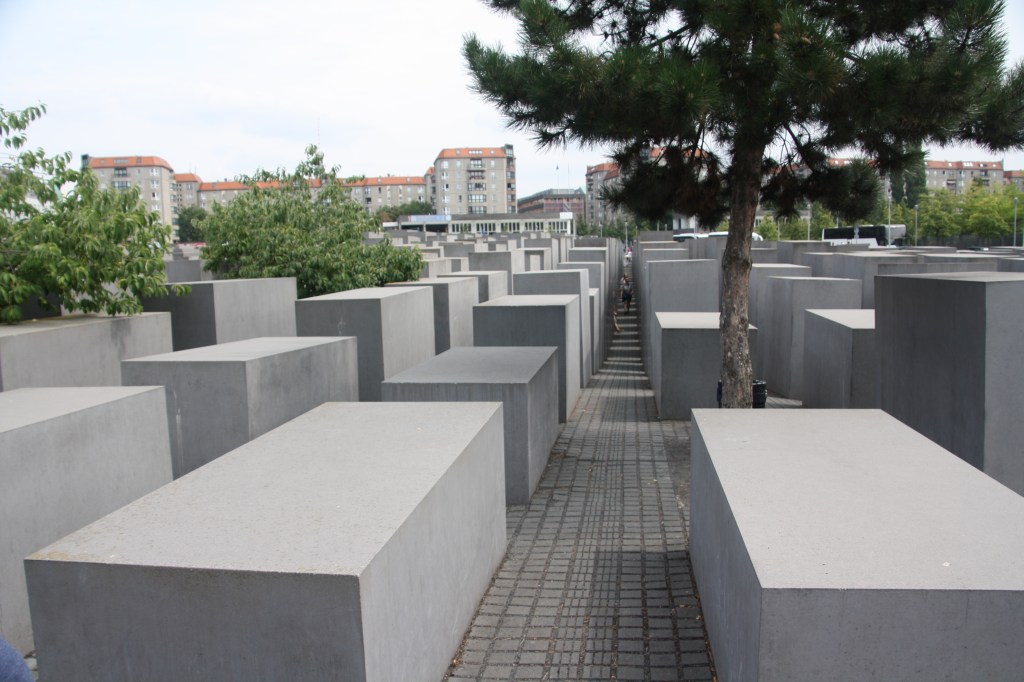
The Memorial to the Murdered Jews of Europe, also known as the Holocaust Memorial, is a memorial to the Jewish victims of the Holocaust, designed by architect Peter Eisenman and engineer Buro Happold. It consists of a 19,000 m2 (4.7-acre) site covered with 2,711 concrete slabs or “stelae”, arranged in a grid pattern on a sloping field. The stelae are 2.38 m (7 ft 10 in) long, 0.95 m (3 ft 1 in) wide and vary in height from 0.2 to 4.7 m (7.9 in to 15 ft 5.0 in). They are organised in rows, 54 of them going north–south, and 87 heading east–west at right angles but set slightly askew. An attached underground “Place of Information” holds the names of approximately 3 million Jewish Holocaust victims, obtained from the Israeli museum Yad Vashem.
Building began on April 1, 2003, and was finished on December 15, 2004. It was inaugurated on May 10, 2005, sixty years after the end of World War II, and opened to the public two days later. It is located one block south of the Brandenburg Gate, in the Friedrichstadt neighbourhood. The cost of construction was approximately €25 million.
Berlin Victory Column
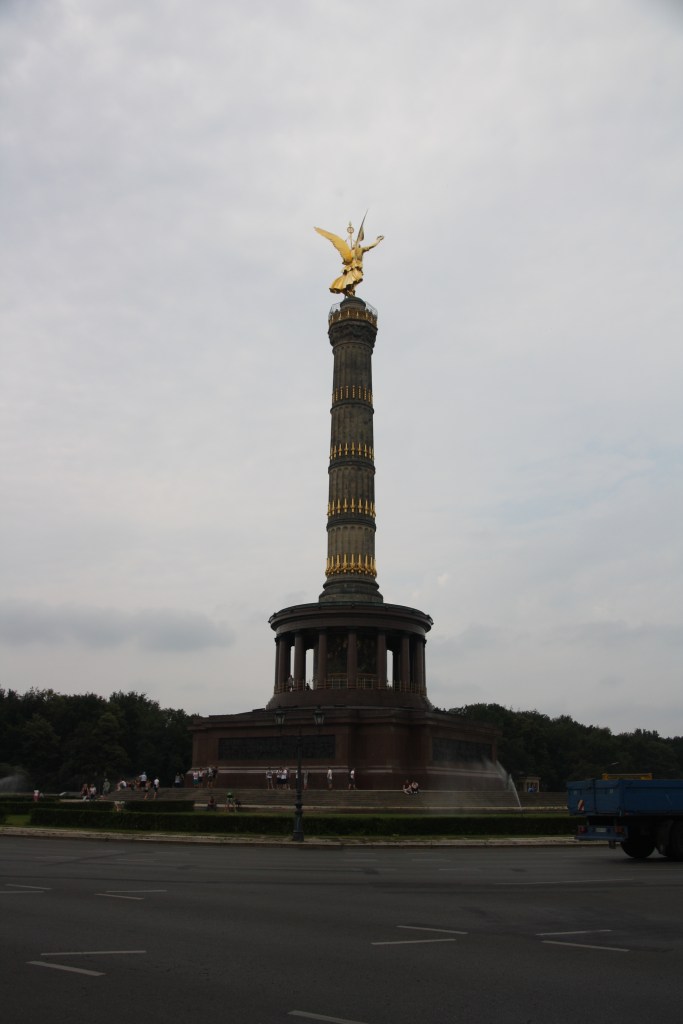
The Victory Column is a monument designed by Heinrich Strack, after 1864 to commemorate the Prussian victory in the Danish-Prussian War, by the time it was inaugurated on 2 September 1873, Prussia had also defeated Austria in the Austro-Prussian War (1866) and France in the Franco-Prussian War (1870–71), giving the statue a new purpose. Different from the original plans, these later victories in the so-called unification wars inspired the addition of the bronze sculpture of Victoria, 8.3 metres (27 ft) high and weighing 35 tonnes, designed by Friedrich Drake. Berliners have given the statue the nickname Goldelse, meaning something like “Golden Lizzy”.
The Victory Column has a viewing platform which offers a view over Berlin.
Berlin Tower
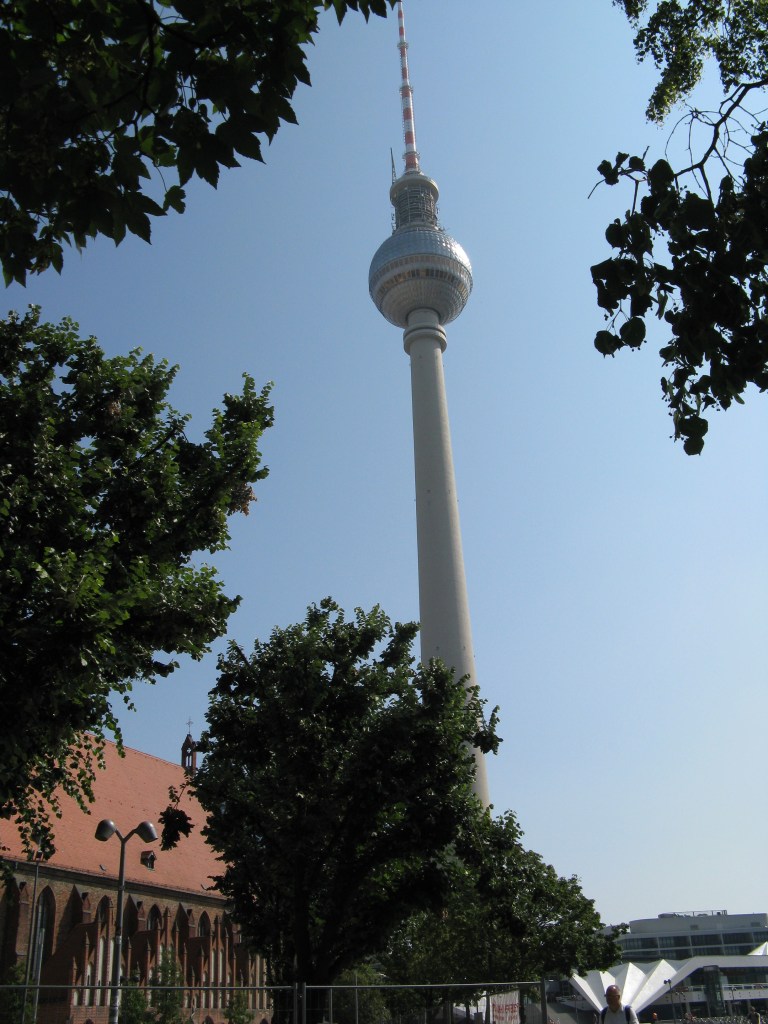
The Berlin TV Tower close to Alexanderplatz, the tower was constructed between 1965 and 1969 by the administration of the German Democratic Republic (GDR). It was intended as a symbol of Berlin, which it remains today, as it is easily visible throughout the central and some suburban districts. With its height of 368 metres, it is the tallest structure in Germany, and the second tallest structure in the European Union (by a half-metre).
The tower has a viewing platform from which there are fantastic views. This is accessed by elevator, of which there are two, which climbs up in less than 40 seconds.
World Clock
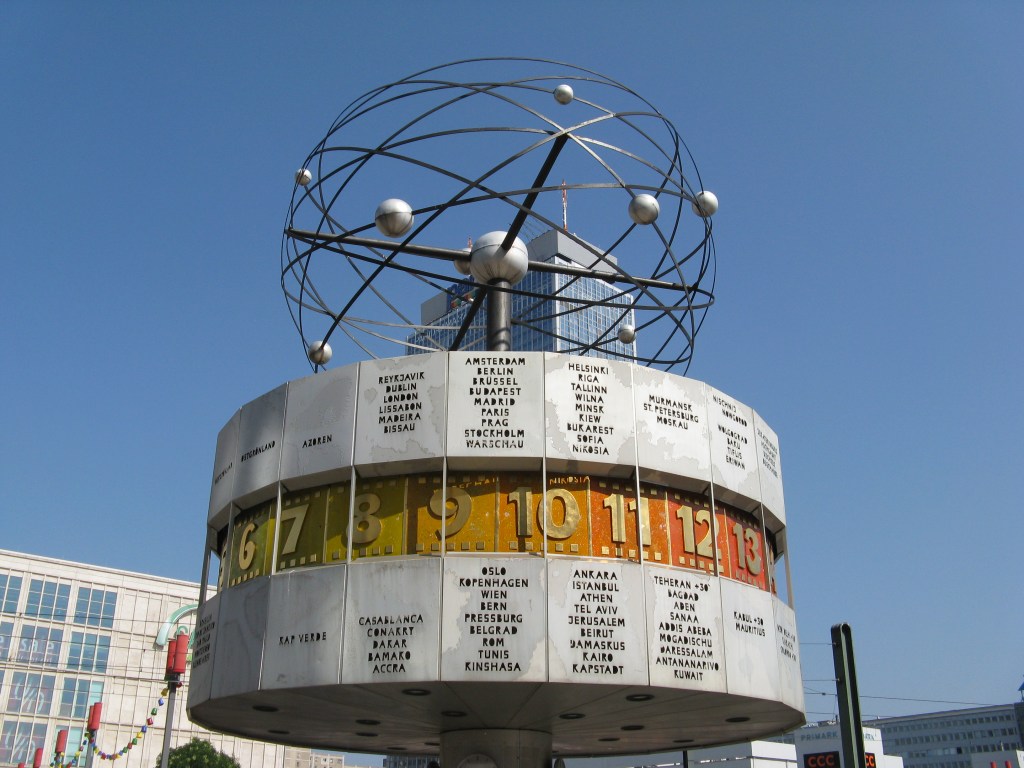
The World Time Clock is one of the Alexanderplatz’s most well-known features. It was constructed in 1969 as part of the square’s redevelopment and has become a popular meeting point.
Weighing 16 tonnes and 10 metres tall, it features a revolving cylinder with the world’s 24 time zones bearing the names of major cities in each zone. The mechanism constructed in a way which enables the current time in each zone to be read.
The clock is topped by a simplified model of the solar system, which revolves once a minute.
Marx-Engels Forum
Marx-Engels-Forum is a public park which is named after Karl Marx and Friedrich Engels, authors of The Communist Manifesto of 1848 and regarded as two of the most influential people in the socialist movement. The park was created by the authorities of the former German Democratic Republic (GDR) in 1986.

Schloss Charlottenburg
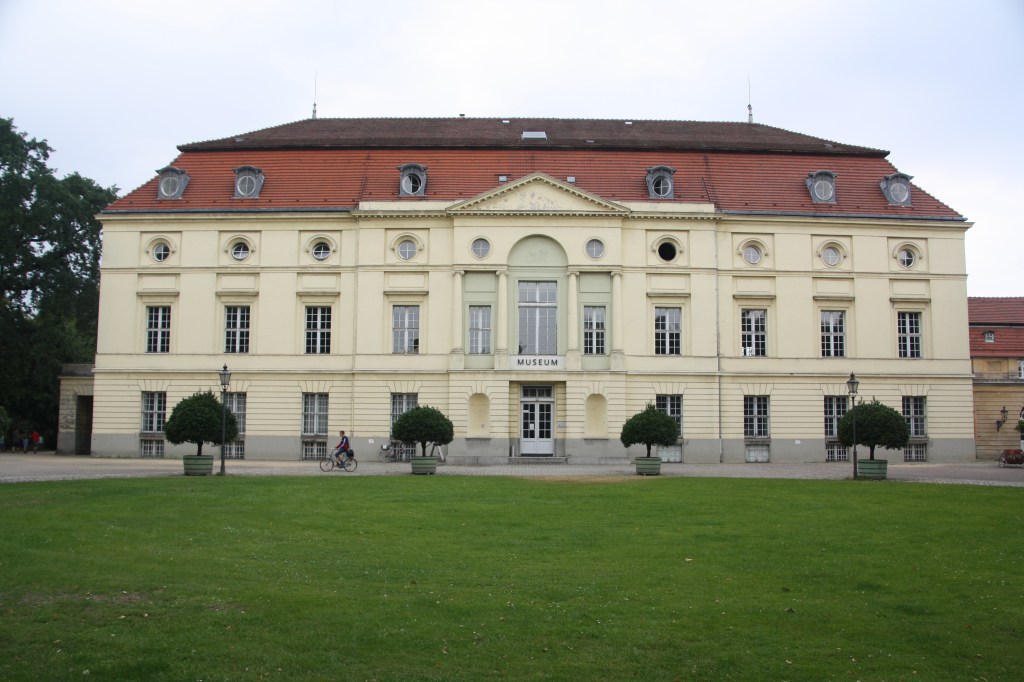
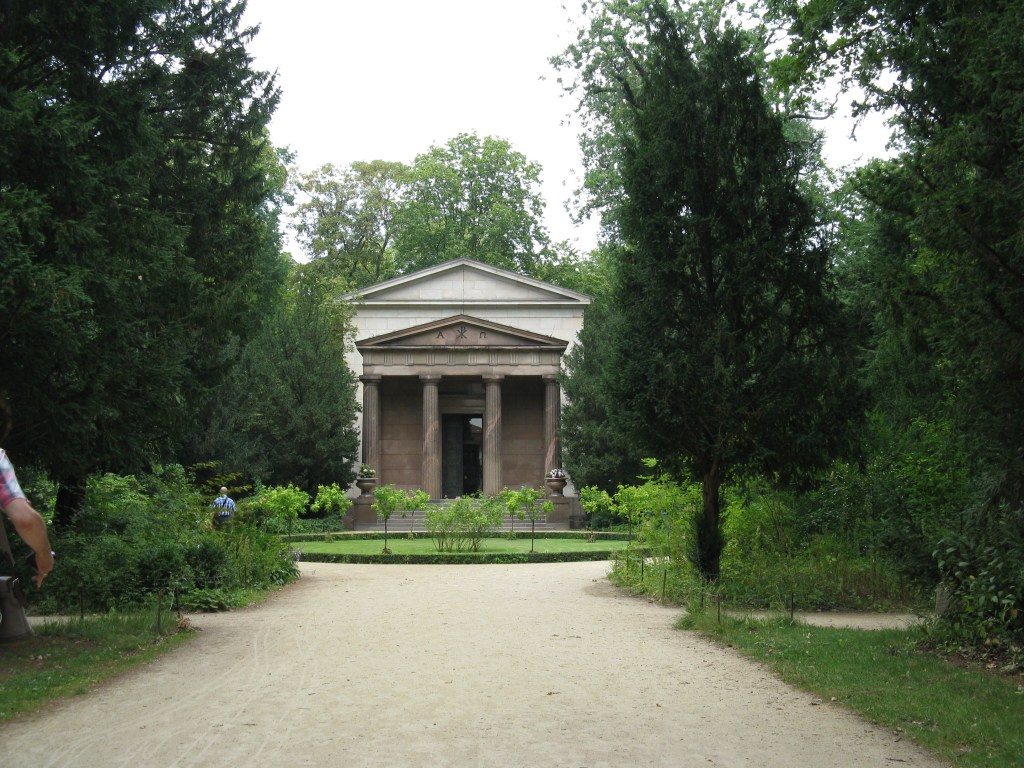
Charlottenburg was built at the end of the 17th century and was greatly expanded during the 18th century. It includes much exotic internal decoration in baroque and rococo styles. A large formal garden surrounded by woodland was added behind the palace, including a belvedere, a mausoleum, a theatre, and a pavilion.
The garden was designed in 1697 in baroque and consisted of geometric patterns, with avenues and moats, which separated the garden from its natural surroundings. Beyond the formal gardens was the Carp Pond. Towards the end of the 18th century, a less formal, more natural-looking garden design became fashionable. In 1787 the Royal Gardener Georg Steiner redesigned the garden in the English landscape style for Friedrich Wilhelm II, the work being directed by Peter Joseph Lenné. After the Second World War, the centre of the garden was restored to its previous baroque style.
During the Second World War, the palace was badly damaged but has since been reconstructed. The palace with its gardens is a major tourist attraction.

Beach Bar
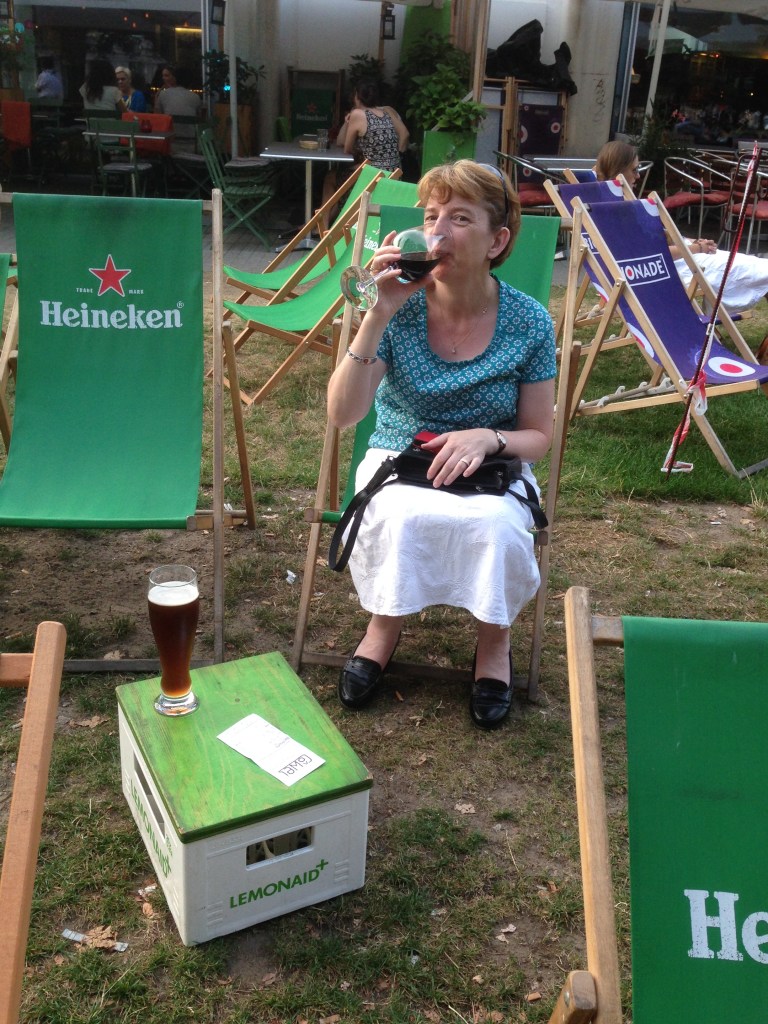
What can be better than a nice cold beer or glass of German red wine (its true Germany makes excellent red wine) on a lovely summers evening in Berlin. So what is the best place to go, obviously head for the beach bar where there are relaxing deck chairs. It doesn’t matter that the nearest beach is over 250 miles away.
Trabant
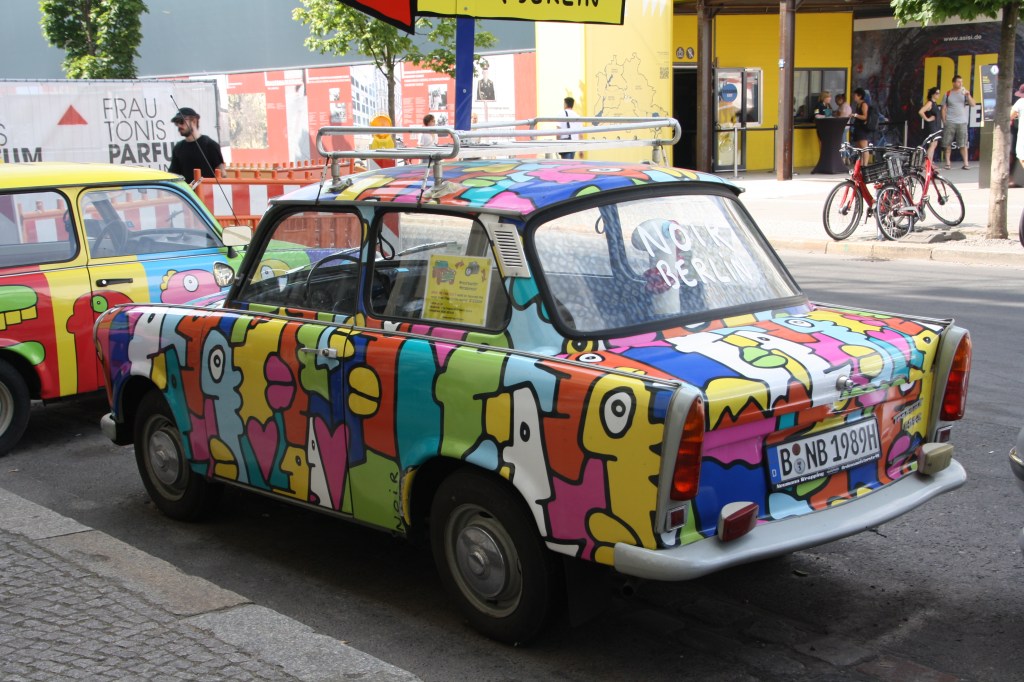
The Trabant is an icon car that was the most common vehicle in East Germany. The name means “satellite” or “companion” in German, the name was inspired by Soviet Sputnik
At the end of production in 1989, the Trabant delivered 19 kW (26 horsepower) from a 600 cc (37 cu in) displacement. It took 21 seconds to accelerate from 0 to 100 km/h (62 mph) and had a top speed of 100 km/h (62 mph). Due to the long waiting period between ordering a Trabant and actual delivery (in some cases, years), used Trabants would fetch higher prices than new ones. The people who finally received their own Trabant treated the car gently and were meticulous in maintaining and repairing it. The lifespan of an average Trabant was 28 years.
The few remaining stand out from the crowd with there artistic pint jobs. I am guessing that this is not the original livery.
 Heather and Keith's travels